
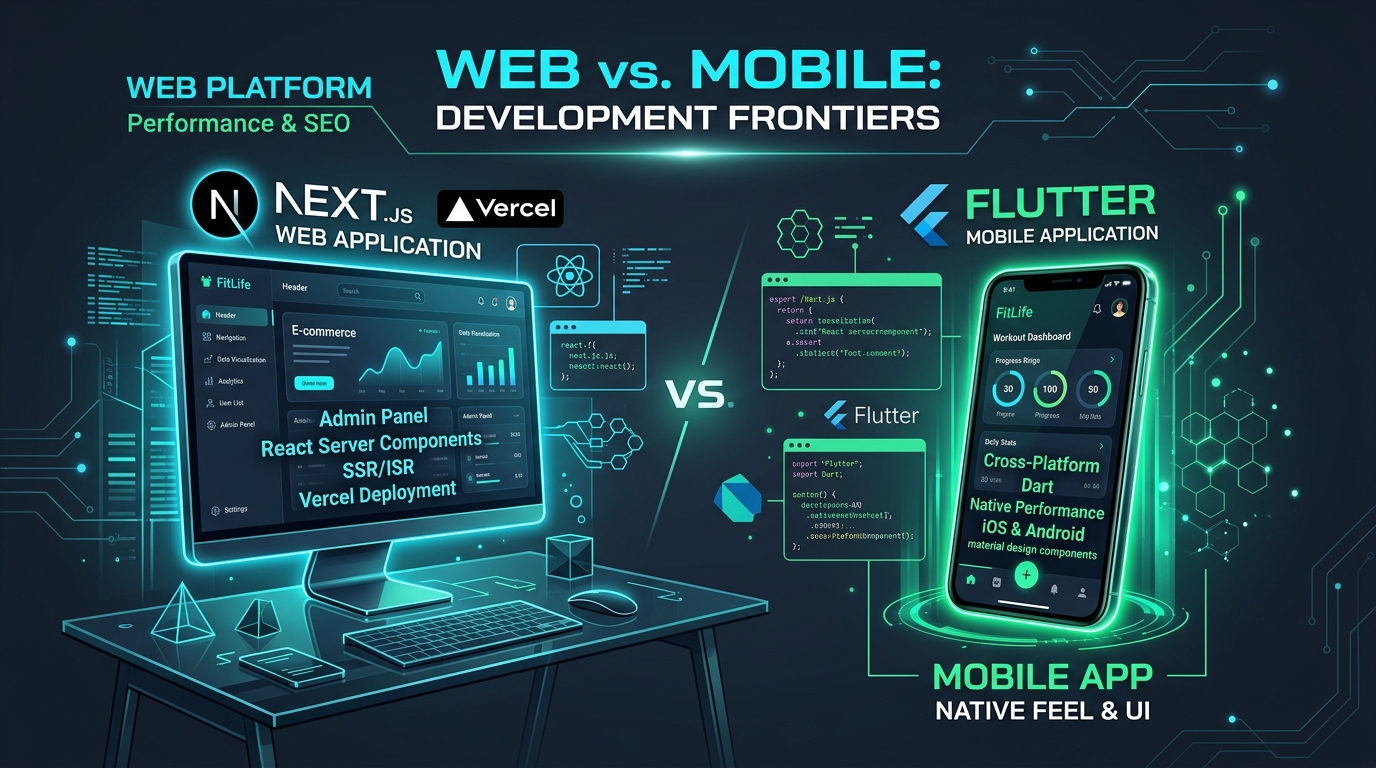
Architecting an MVP: Next.js vs Flutter, and How We Chose for FirmFlow AI and Blyno Academy
Every founder building an MVP hits the same fork: web-first with Next.js, or cross-platform with Flutter. Get it wrong and you either over-build for a market that wanted a browser tab, or under-build for a workflow that needed a phone in someone's pocket. Here's the framework we actually use at Blyno, illustrated with three of our own builds.
The real decision variable isn't "web vs mobile" it's distribution
Founders frame this as a technology choice. It's actually a distribution choice. Ask: does your first 100 users reach your product through a link (Slack, email, WhatsApp) or through a home-screen icon they open five times a day?
FirmFlow AI our legal workflow automation platform for advocates and law firms is a daily-use B2B SaaS tool. Lawyers and staff open it at a desk, alongside case documents and email. Distribution is a link shared by the firm's admin. We built it on Next.js, Tailwind CSS, and Supabase, deployed on Vercel. No app store review cycle standing between a signed contract and a live account.
SafeWalk Mobile our safety navigation app with real-time GPS tracking needed background location access, push notifications for emergency contacts, and offline-tolerant behavior. None of that is a good fit for a browser tab. We built it in Flutter with Dart, Firebase, and the Google Maps SDK, shipping a single codebase to iOS and Android.
Decision framework
Choose Next.js when:
- The core workflow is data entry, review, and reporting (case management, dashboards, admin panels)
- Your buyer needs to demo it before they trust you enough to install anything
- SEO and organic discovery matter to your growth model
- You need server-rendered pages for fast first paint and indexability critical if your MVP itself needs to rank
Choose Flutter when:
- The product depends on device sensors GPS, camera, biometrics, push notifications
- Users need offline-first behavior
- You need one codebase to hit iOS and Android without doubling your engineering headcount
- App-store presence itself is a trust signal for your market
What this looked like in practice: Blyno Academy
Blyno Academy our EdTech platform embedding professional IDEs directly inside lessons for Indian college students is a hybrid case. Students code inside the browser (no setup friction, which meant Next.js was non-negotiable), but the platform runs on PostgreSQL and AWS RDS/EC2/S3/Route 53 underneath, because course content, code execution sandboxing, and progress tracking needed infrastructure control a managed BaaS wouldn't give us at scale. 500+ students in the first cohort, 92% completion rate three times the industry average for online tech courses. The infra choice mattered as much as the frontend framework choice.