How Search Engines Work: Crawling, Indexing, and Ranking Mechanics Explained
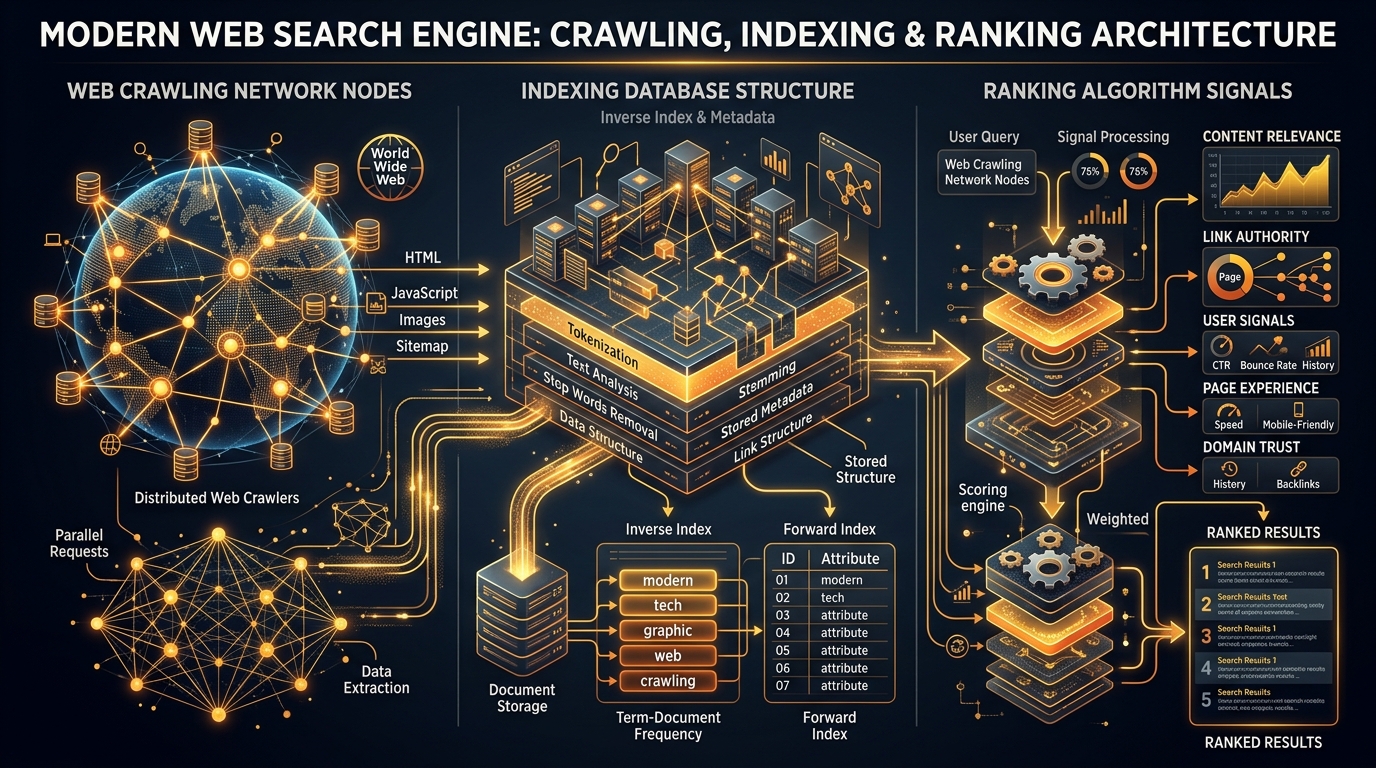
Search Engine Optimization (SEO) begins with understanding what happens under the hood when a search engine interacts with your site. Before a webpage can ever appear at the top of Google search results, it must pass through three distinct, automated phases: Crawling, Indexing, and Ranking.
1. Crawling: How Google Discovers Your Pages
Google relies on automated software programs known as crawlers or spiders (specifically Googlebot). Crawlers traverse the web by following hyperlinks from one page to another. When Googlebot discovers your website, it requests the page's HTML file and associated resources (CSS, JS, images).
Key factors that govern effective crawling include:
- Crawl Budget: The number of URLs Googlebot will crawl on your site during a given timeframe. Fast, well-structured servers receive higher crawl efficiency.
- Robots.txt Directives: The text file that instructs crawlers which areas of your site to fetch or ignore.
- XML Sitemaps: A structured blueprint containing all public URLs you explicitly want engines to discover and prioritize.
2. Indexing: Storing and Processing Your Web Content
Once a crawler fetches a page, Google renders the HTML and JavaScript, parses the content, and stores it in the massive Google Index—a global database containing trillions of web pages. During indexing, Google analyzes:
- Text & Semantic Context: Headlines (<h1>, <h2>), main body paragraphs, and semantic HTML structure.
- Meta Tags: Page titles, meta descriptions, and canonical tags that define the canonical URL.
- Images & Rich Media: Alt texts, image filenames, and embedded structured data (JSON-LD).
If a page is blocked by a noindex meta tag, returns server errors, or contains heavily duplicated content, Google will drop it from the index.
3. Ranking: Computing Relevance & User Intent
When a user types a query into Google, the search engine evaluates indexed pages in real time using hundreds of ranking signals. Modern search ranking is driven by AI models such as RankBrain and MUM, which focus on search intent rather than simple keyword stuffing.
Primary Ranking Factors:
- Content Quality & E-E-A-T: Experience, Expertise, Authoritativeness, and Trustworthiness. High-value content answers user queries thoroughly.
- On-Page Keyword Optimization: Strategic placement of primary and secondary keywords in page titles, URLs, headings, and introductory paragraphs.
- Technical Health & Core Web Vitals: Page load speed, mobile-friendliness, cumulative layout shift (CLS), and HTTPS security.
- Backlink Profile & Domain Authority: Links from authoritative, relevant external websites act as digital votes of confidence.
Summary Checklist for Business Owners
To ensure search engines can properly process your website:
- Keep your site hierarchy clean and logically organized.
- Ensure Googlebot can render JavaScript efficiently (using SSR or pre-rendering).
- Publish authoritative, original content aligned with real user search queries.